

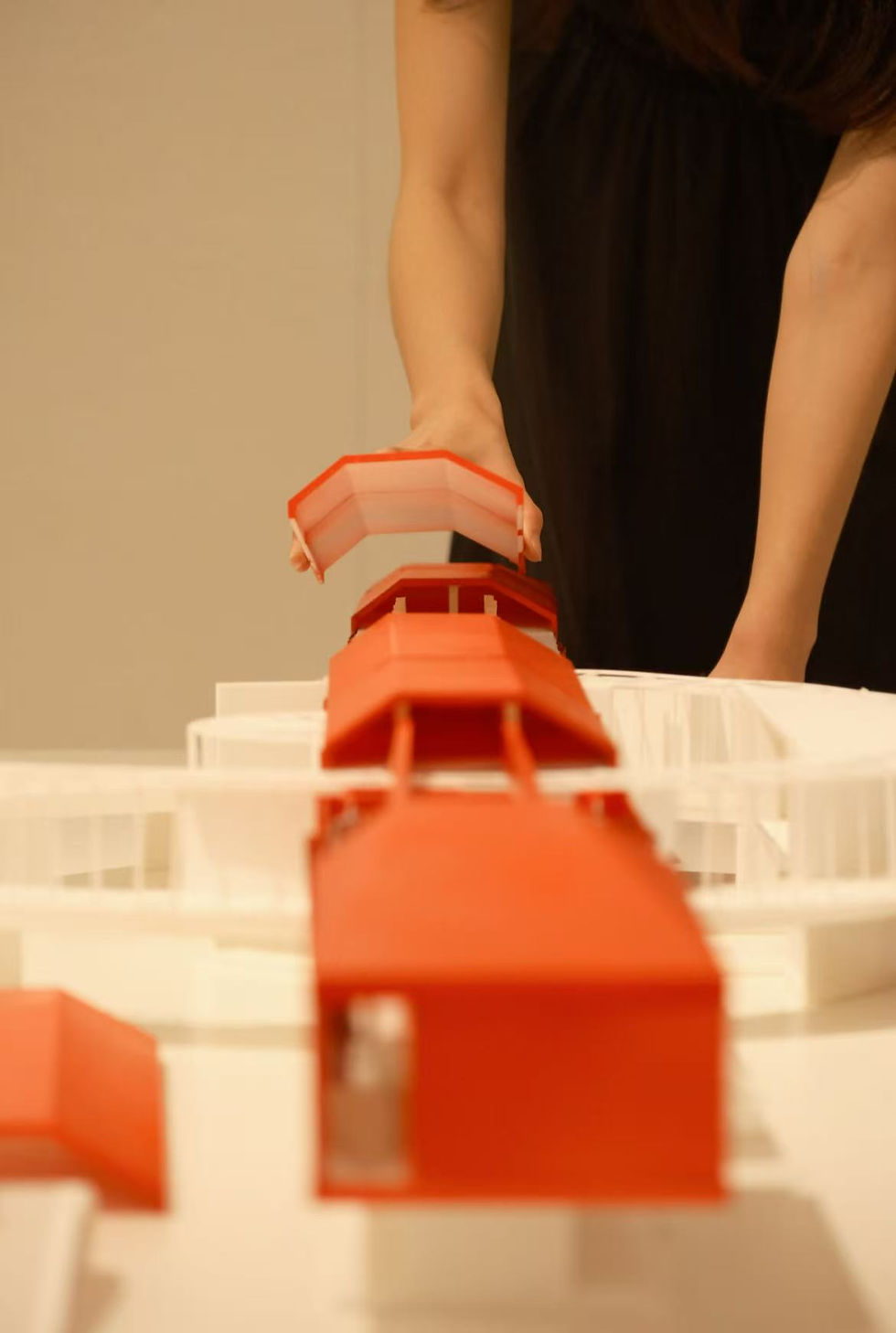


Urban Field
Cultivating Culture through Food and Nature
St. Louis, Missouri, USA
The project is an open market combined with a community garden, designed to revitalize Fairground Park in North St. Louis by reconnecting it with both the community and its history. Once home to the Agricultural Exposition, the park has become underutilized despite its historic features like the abandoned bear pits and a swimming pool that once served as an amphitheater for horse racing. Inspired by local urban farming and the need for greater access to healthy food, this proposal introduces a market along the middle drive in the park, strategically placed for accessibility, natural light, and connections to walking and cycling paths.
The design includes a market, shared garden, fishing area, and a bridge that connects the park’s existing roads. The building uses geometric forms, thin lines, and circles as symbolic representation, contrasting with the landscape’s natural curves. This dynamic interaction revives the park’s lost identity, infusing it with modern energy and renewed purpose, blending architecture and nature in a contemporary, meaningful way.
Individual Work
Spring 2025
Professor: Chandler Ahrens
click here to walkthrough animation

In this project, I used three different collages to present my concept, the site's history, and the design strategies.
The collage on the left represents the my concept.
As the title of my project said, I found a unique location within the various “fields” of the city.
I am gonna to use the architecture to reshape the landscape of this site and reactivate this community.
Why a “spoon”? Why this particular piece of land? Scroll down to see my site research for the answers....
Our task was to select a site within the boundary marked by the dashed line. Through my research, I identified Fairground Park as an area facing significant socioeconomic challenges, including low income levels, high unemployment, limited access to fresh and healthy food, and an overabundance of fast-food options. Currently, only one grocery store exists within a mile of the site, leaving many residents without convenient access to nutritious food.
However, a planned light rail system nearby is expected to become a critical economic driver, enhancing accessibility and attracting new investment to the area. This infrastructure development presents a strong foundation for broader revitalization efforts.
Moreover, the site's rich historical background offers a unique opportunity to create a development that not only addresses food insecurity and economic hardship, but also celebrates and preserves the cultural identity of the community.
By prioritizing thoughtful, community-driven strategies, the site has the potential to become a model for equitable urban development, promoting healthier lifestyles, economic resilience, and cultural vitality. These efforts could not only reshape the site but also reinforce the social fabric of the surrounding neighborhoods.

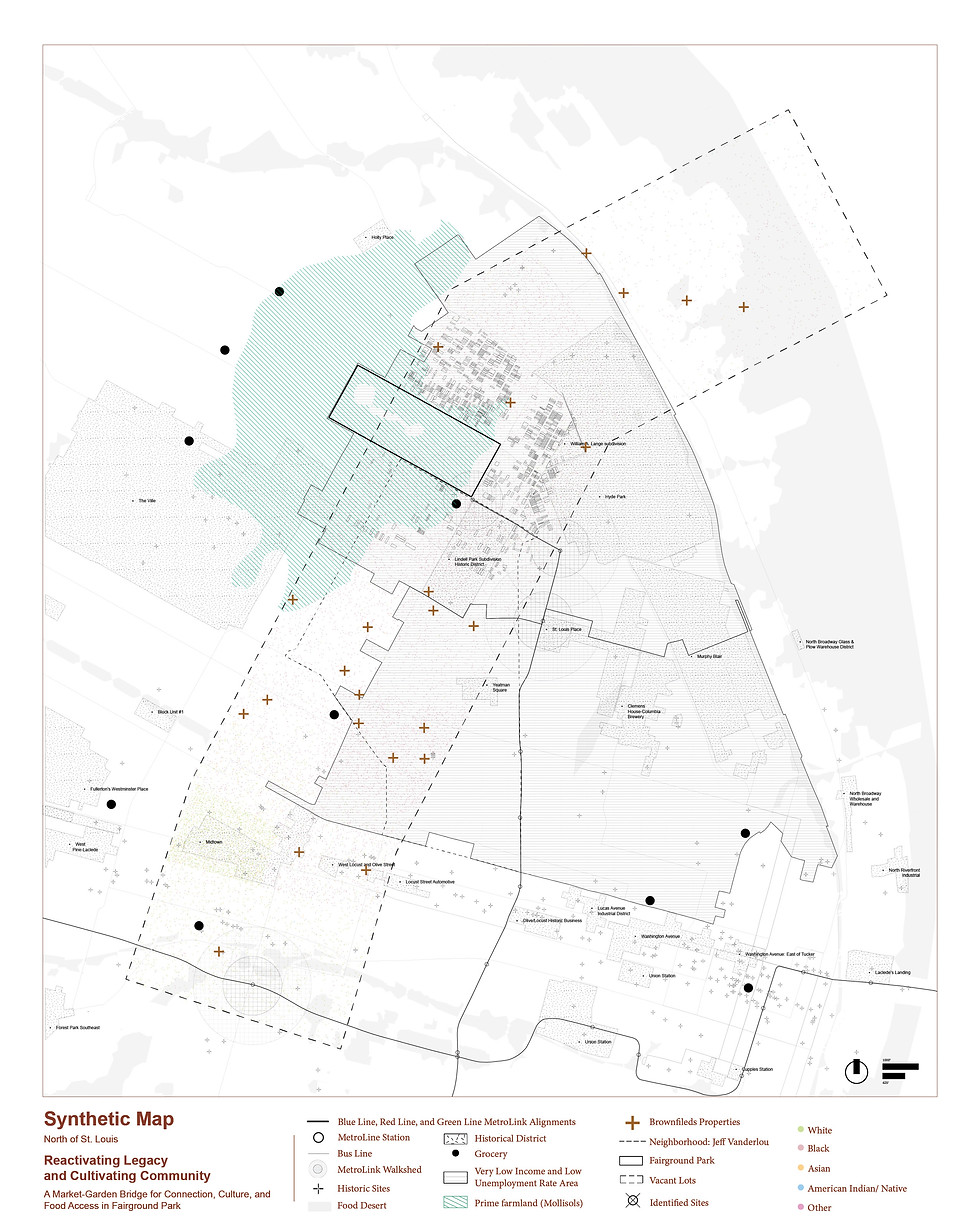
my site: Fairground Park
As parks are valuable community gathering spaces, which can play a key role in revitalizing the area and fostering a more cohesive future for local residents. The Fairground Park, the eastern area of the site once had a prosperous past with St. Louis Exposition of Agricultural and Mechanical Association, including a couple of amphitheaters for horse racing, and a zoo. But the entire park has faced decay over many years, resulting in a barren, underutilized landscape. Currently, the whole park is still a good farmland but occupied by many sports fields, with a lake situated in its western section, the amphitheater became to an abandoned swimming pool, and the zoo became to only broken bear pits remaining near the southeastern entrance.
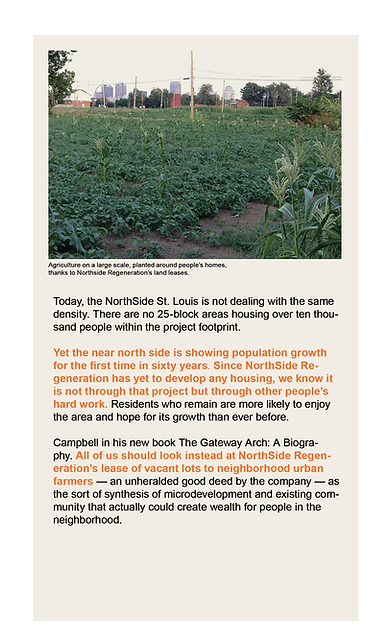
Some residents are already using vacant lots or their backyards for urban farming in St.Louis, a grassroots initiative that generates community wealth. However, the challenge lies in the lack of water sources and available land, prompting residents to find solutions to this issue.
Building on this effort, above challenges, and to fully use the potential benefits of the park, I propose creating an open market combined with a community garden in Fairground Park, providing fresh food, a vibrant gathering space, and opportunities for urban farming. Beyond serving the residents, this initiative would also reshape the park’s landscape and revive its lost history.
This market will not only activate the space but also create a dialogue with the park’s existing historic structures and its lost heritage. The project should feature open and flexible market stalls, a community garden where local residents can plant and learn, an expanded fishing area along the lake, as well as open plazas and amphitheaters for gatherings and events.
This initiative aims to improve access to healthy food, support economic and spatial opportunities, and foster cultural cohesion and community engagement.


my site: along the drive road and the lake
Broken Bear Pits
Broken Bear Pits
Abandoned swimming pool
Previous amphitheater for horse racing
Lake view

Click here to Fairground Park
Broken Bear Pits
my site
There is a drive road running through the middle of the park, I selected a site along this road. The building will be laid out linearly, with parking arranged alongside the road to provide convenient access for the market. This orientation offers good natural ventilation and daylight. More importantly, one side faces the lake while the other overlooks the historic bear pits, allowing the new architecture to establish a dialogue with the historical site in both height and orientation.
Another key feature of this location is that it sits at the convergence of three circulation paths: a walking path, a bicycle trail, and a drive road. This intersection enhances accessibility and makes the site an ideal node for community engagement and daily activity. Placing the building near the lake also allows the integration of fishing which is an existing activity on the site into the market’s program.


This project, titled Urban Field, aims to reactivate its legacy and cultivate the community. I designed this market-garden bridge on this unique site within Fairground Park to promote connection, culture, and food access.
The design strategy is based on two main aspects:
-
Gather and provide fresh food
-
Reactivate Fairground Park and rediscover its lost history
1. Gather and Provide Fresh Food
This aspect is guided by three design principles:
-
Harmonious: This is why the building is pushed toward the water, preserving the existing trees in front. It also creates a more intimate connection between the fishing activities and the water, integrating nature and human activity.
-
Accessible: The architecture follows a linear layout for maximum convenience. As mentioned earlier, the parking is placed along the road, and the building connects three different paths on the site: a walking path, a bicycle trail, and a drive road, offering multiple points of access and opportunities for encounter.
-
Vibrant: The existing circulation paths are integrated into the architecture. A bridge structure is created as part of the building, connecting both sides of the site. This bridge serves not only as a passage but also as one of the main entrances, encouraging movement and social interaction.
2. Reactivate Fairground Park and Rediscover Its Lost History
This strategy considers the site's historical remnants, such as the former horse-racing amphitheater and the broken bear pits. I was using the symbolic representation in my building to reactivate these lost history.
The previously mentioned bridge is combined with architectural space to form a circular structure, reinterpreting the historical amphitheater. The circular space becomes a new arena for temporary markets, picnics, and performances. A thin line that intersects the circle is oriented toward the bear pits, creating a spatial dialogue between the new architecture and the historic site.


click the arrow to see my site plan


Indoor permanent market in the bar shape with triple-layer facade
Video generated by AI

Community garden in the circular shape (green house with water tanks collecting rain water)
Video generated by AI

The feature of this building is its striking 15-foot-high, 580-foot-long bar-shape market, which hovers above the water, supported by two grounded structures. This suspended space relies on a sophisticated structural system composed of two identical sets of four massive cross-laminated timber (CLT) beams, each 6 feet high. These beams span 80 feet, 80 feet, 80 feet, and 50 feet from west to east, forming the market’s primary framework.
To achieve its floating effect, the CLT beams are integrated with steel trusses that suspend the entire elongated space. The trusses are supported by slender steel columns with a cross-sectional dimension of 0.5 feet by 0.5 feet, spaced 6.5 feet apart. This configuration allows for the placement of 6.5-foot-wide concrete metal decks on the trusses, forming a rigid yet efficient load-bearing system. The CLT beams are further stabilized by diagonal and horizontal steel beams, while steel cables connect the horizontal beams, creating a balance between compression in the CLT beams and tension in the trusses and cables.
The market’s façade enhances its architectural elegance with a double-layered system of movable louvers and a glass curtain wall. This design maximizes natural light and ventilation while offering a dynamic interplay of solidity and transparency. Integrated greenery between the louvers and glazing further enhances the market’s visual lightness, reinforcing its distinctive, suspended appearance.



four massive cross-laminated timber (CLT) beams

The lower portion of the bar is finished with the same paving material as the surrounding environment, which enhances the floating appearance of the bar.


The permanent market is divided by hollow walls, which conceal all plumbing and electrical conduits. Workstations are attached to both sides of the walls, providing water and electricity to each individual stall in the market.

At the intersection of the community garden and market spaces, there are four doors in different directions, ensuring that both spaces remain open during the day.
At night, the two doors leading to the market are closed, while the community garden remains open overnight. People can also access the fishing area for night fishing through the community garden. The circular community garden has no corner spaces, and its walls are entirely transparent, people can from the outdoor bridge to the community garden, ensuring safety at night.


Amphitheater with temporary market stalls

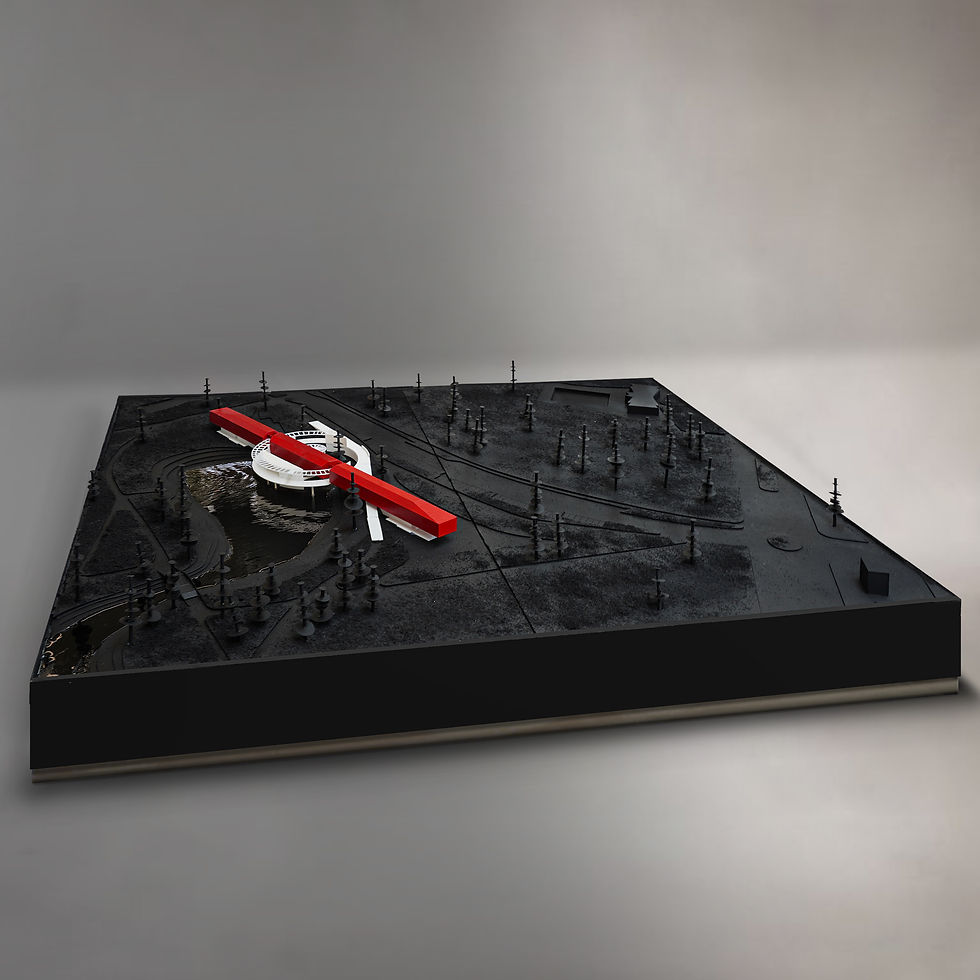
Site Model

four massive cross-laminated timber (CLT) beams

