
Light Threshold
Housing Design in Barcelona
Barcelona, Spain
Individual Work
Fall 2023
Professor: Emiliano Lepez
La Barceloneta was the first neighborhood built outside the city walls of Barcelona. It was completed in 1779 and represents the first massive and fast housing development in the history of Barcelona. Th e original military plan was based on two stories row houses to conform a strict grid of linear blocks of ten houses. The family house dimension was established as 10 by 10 varas. A vara (meaning rod or pole) is an old Spanish unit of length in use until the end of XIX century. One vara equals 0,84 meters, almost 3 feet. In its origins the neighborhood hosted families, commerce, industry and leisure activities related with the port of Barcelona and the sea. With the relentless growth of population and immigration, the 141,12 square meters (1.519 square feet), two stories single family row houses, where divided in what was known as “quarter houses” of 35,28 square meters (379 square feet). Th e original two-storey 7 varas tall houses proposed, spontaneously grew in height reaching six-storeys by the end of XIX century. Th is rapid increase in height ended up in a high density of 340 dwellings per hectare that still prevails today and continues to host the famous “quarter houses” next to the redeveloped Barceloneta beach in 1995. The dwindling local population cohabits with the speculation and uncontrolled low-cost tourism.
The concept of this project adapts the high-density community in Barcelona. The spatial arrangement creates the lighting gradient from the dark foyer to a brighter outdoor space, as well as the division of public and private realms. Spaces in different shapes with similar size provide flexible usage of rooms and the rich potential of cross views, which accommodated to dwellers with various income. The use of ventral shafts at the center and the adjustable louvers enveloped the apartment is designed for pleasant lighting condition and climate change. Althese together evolves the living quality and creating modern lifestyle in Barcelona.
In the first five weeks of this studio, we explored residential designs in two completely different countries. Rather than focusing purely on design, the process was more about understanding local architectural styles through the creation of physical models and collages.
The first site our group focused on was New Orleans, USA.
Due to its climate, New Orleans enjoys abundant sunlight, which creates stunning light and shadow effects in its architecture. Before diving into the design process, we were introduced to the city through two films set in New Orleans—A Streetcar Named Desire by Tennessee Williams and Down by Law by Jim Jarmusch. These films vividly capture the city’s distinctive architectural atmosphere and the interplay of light and shadow, both of which exquisitely represent a particular domesticity that is only from New Orleans.
Our studio’s site was the Vieux Carré, also known as the French Quarter, the oldest and most iconic neighborhood in New Orleans. It’s a vibrant, complex mix of locals and tourists, introversion and extroversion, sacred and profane. Architecturally, it’s one of the most densely residential areas in the United States, shaped by French, Spanish, and Afro-Caribbean influences. We studied housing typologies such as Creole Townhouses, Creole Cottages, and Shotgun houses. Our studio was tasked with proposing dense, mixed-income, mixed-use housing to replace existing parking lots along Rampart Street. While acknowledging the area's rapid transformation and recent developments, including a new streetcar line, we aimed to strike a balance between contemporary socio-demographic needs and the historical identity of the neighborhood. In our designs, we respected the block-and-courtyard morphology, embracing the layered interplay between interior and exterior spaces, often connected through covered outdoor transitions that reflect the unique spirit of New Orleans.
Our physical models and collages were intentionally made in black and white to emphasize these dramatic lighting effects.

A Streetcar Named Desire by Tennessee Williams

Down by Law by Jim Jarmusch


We turned our lens toward the concept of the "threshold" in architecture.
In New Orleans, my perspective looked outward from the living room toward the exterior. I titled this scene "Stage", inspired by the city’s multicultural and tourism-driven atmosphere, where spontaneous performances seem to happen everywhere and at any time. The scene I created captures the moment after an artist has finished an afternoon balcony performance, leaving behind a slightly chaotic yet poetic stage, a trace of everyday theatricality unique to New Orleans.
After “spending” three weeks in New Orleans, we then “moved on” to Barcelona, Spain.
This was also the site where, for the rest of the studio, we finally began our affordable housing design work. As with the earlier phase, we also started by creating physical models and collages to understand the local housing characteristics and spatial language of the area.
The Emergence of Octagonal Blocks
In the mid-19th century, Barcelona underwent rapid expansion due to industrialization, and the old Gothic Quarter could no longer meet the needs of its growing population. In 1859, urban planner Ildefons Cerdà introduced the famous “Eixample” (expansion) plan, featuring a grid system composed of octagonal blocks. Unlike traditional tight street layouts, Cerdà’s design cut the corners of each block to create chamfered intersections, improving visibility, ventilation, and access to natural light. This rational and modern approach transformed the city from a dense, inward-looking structure into a more open and breathable urban fabric. It reflected a forward-thinking vision of health, equality, and connectivity, and has since become a defining characteristic of Barcelona’s urban identity.


Plan of the Eixample development in Barcelona (1859), by Ildefons Cerdà. Illustration: Archives of the Kingdom of Aragon, Barcelona/Ministerio de Cultura/Ministerio de Cultura
Barcelona’s Eixample district, with Antoni Gaudí’s Sagrada Familia in the foreground. Photograph: Amos Chapple/Rex
Source from:
Constricted by its medieval walls, Barcelona was suffocating – until unknown engineer Ildefons Cerdà came up with a radical expansion plan. Rival architects disparaged him, yet his scientific approach changed how we think about cities
The Rise of Superblocks and Cycling Culture
In recent years, Barcelona has launched the “Superblock” (Superilla) initiative in response to traffic congestion and air pollution. This urban strategy groups nine regular blocks into one unit and restricts car traffic within the interior, giving priority to pedestrians, cyclists, and public transit. The goal is to reduce noise, lower emissions, and reclaim public space for community life. Streets once dominated by cars are being transformed into lively plazas, green corridors, and social gathering spots. With the rise of the Superblock model, bicycle use has significantly increased, and the city has expanded its cycling infrastructure. This movement marks a shift toward sustainable urban mobility and positions Barcelona as a leading example of people-centered urban design.

Network of new green axes and squares
Source from:
Barcelona’s Superblocks and Green Axes, a Pathway Towards a More Sustainable City


Poblenou Superblock


In Barcelona, I directed my lens toward the entrance of an affordable housing building located within a Superblock. The view looks outward from the shared ground-floor space toward the street. Again focusing on the interplay of light and shadow, I highlighted the gradual transition from darkness to light. This contrast is not only visual but also symbolic of Barcelona’s evolving urban values. Within the Superblock model, where streets are reclaimed for pedestrians and communal life, the building entrance becomes a meaningful threshold between private domesticity and an increasingly activated public realm. The moment of emerging from a shaded, quiet shared space into the sunlit, walkable street reflects the city’s commitment to sustainable living and human-centered design.
Next, we began developing our own affordable housing designs. I continued to explore the concept of light and shadow—specifically the transition from darkness to light—as a central spatial strategy.
There are 12 people in our group, and we all worked on the same site. At the end of the design phase, we placed all of our individual buildings together onto the shared site.

Click here to our site...


my building
Thank you to Hannah for taking this photo of our site from the airplane.


The concept of this project draws inspiration from the high-density urban fabric of Barcelona, particularly within the Superblock model. It emphasizes the coexistence of communal living and individual privacy in a compact site.
The design is structured around four core strategies:
urban form and density, spatial sequencing and light, flexible living units, and climate-responsive elements.
Urban form and density
The overall massing of the building is composed of asymmetrical polygons derived from the cutting and aggregation of pentagons. This irregular geometry reflects the condensed and complex nature of life in a dense city like Barcelona. By avoiding rigid symmetry, the building captures the layered character of the urban fabric—where buildings, public space, and circulation constantly interact. The faceted edges and dynamic orientations help break down the scale of the mass while creating unique spatial pockets and view corridors within the site.
The spatial layout creates a deliberate transition from darkness to light, starting with a shaded, compressed foyer that gradually opens toward a brighter, semi-public outdoor space. The outdoor circulation is shaped to offer alternating narrow and wide spatial conditions, enhancing the rhythm of movement through shifting scales and light qualities. These outdoor spaces serve as both connectors and thresholds, softening the edge between private residences and the shared public realm.
Spatial sequencing and light
Flexible living units
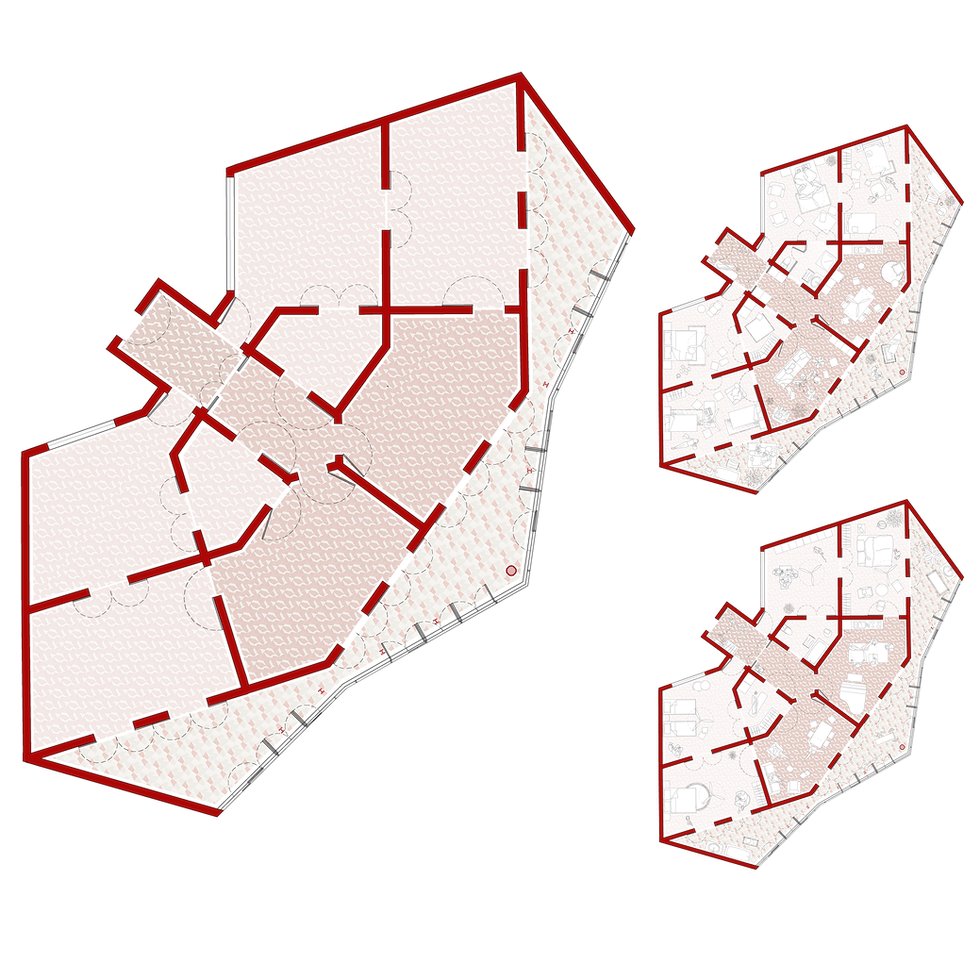
The units are designed in similar sizes but varied shapes, allowing for flexible internal arrangements that accommodate different family structures and income levels. This diversity in layout supports a broader range of lifestyles and fosters inclusivity. The shifting geometries and doors for each room enable visual connections across spaces and different source of sunlight, while maintaining appropriate degrees of privacy, contributing to a vibrant, socially connected living environment.
To respond to Barcelona’s Mediterranean climate, the building employs multiple passive ventilation and lighting strategies that enhance indoor comfort while minimizing energy use. A large central ventilation shaft at the core of the building facilitates natural airflow throughout the complex, promoting passive cooling. Additionally, each individual unit includes a smaller shaft near the entrance, specifically designed to bring in natural light and enable cross-ventilation within the apartment. The façade is equipped with adjustable louvers and operable glazing, allowing residents to passively regulate sunlight, airflow, and privacy based on seasonal and daily conditions.
Climate-responsive elements

The design of the ground floor follows the structural logic of the upper levels, with the supporting walls aligned vertically to ensure efficiency and continuity. Along the perimeter, the ground floor is programmed with commercial spaces and laundry room that activate the street edge and contribute to the public life of the neighborhood.
Between these commercial spaces and the central courtyard lies a semi-enclosed layer designated for bicycle parking. This buffer zone supports sustainable transportation while softly transitioning from the active commercial edge to the quieter communal core. At the heart of the site, the courtyard functions as a public space for gathering, relaxation, and social interaction, reinforcing the project’s emphasis on community life and accessible, shared open space.
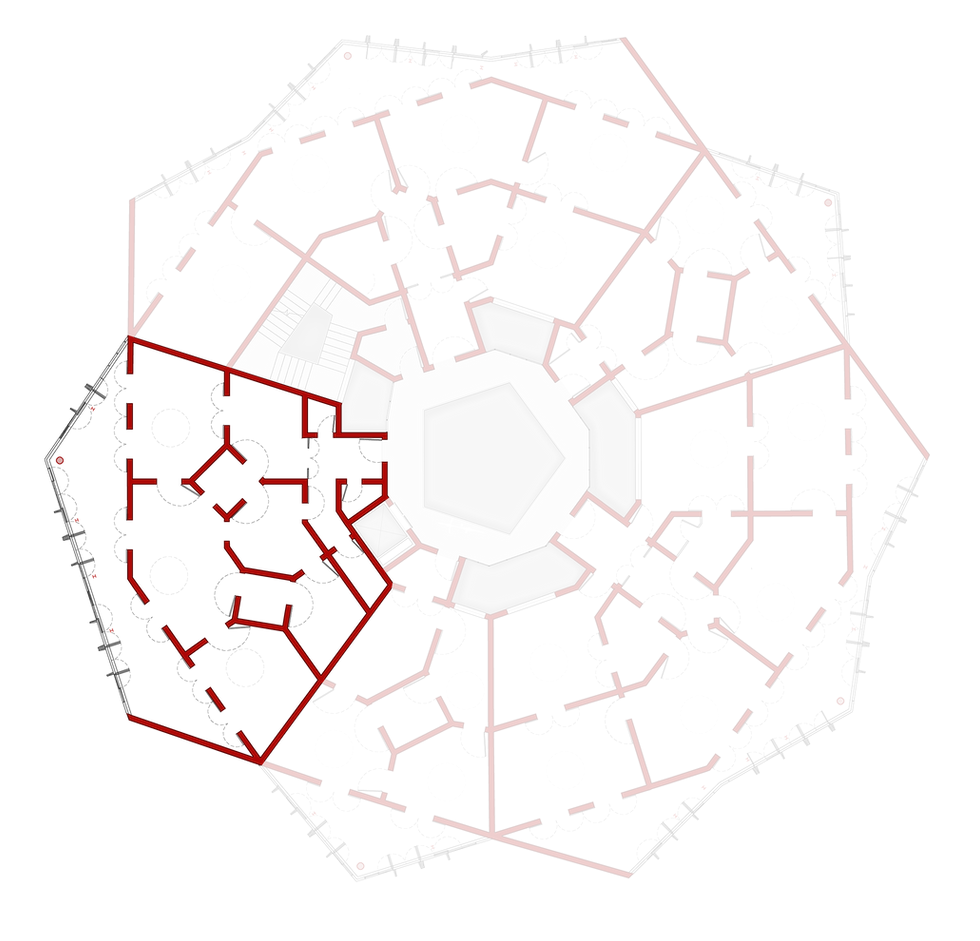
Each floor contains five residential units, composed of four distinct unit types.
This variation in layout allows for a mix of living arrangements, accommodating different household sizes and lifestyles.




The primary structure of the building consists of CMU (concrete masonry unit) load-bearing walls, which carry vertical loads efficiently through compression. To support the outdoor spaces, that extend beyond the main structure, a large steel I-beam is installed above the roof. These I-beams are connected to the outdoor platforms using tension cables, effectively suspending the outdoor spaces.


